Voicebot AI is reshaping the future of customer service by making it easier for people to communicate with brands and get help quickly. With AI virtual agents (agentes virtuales en IA), customers no longer have to wait on long phone calls or navigate complicated menus. They can simply speak, be understood, and receive the information or support they need in just a few seconds. This creates faster, smoother, and more satisfying experiences for customers, while businesses save time, reduce costs, and improve the way they deliver services.
At the same time, companies are exploring how advanced cloud-based AI solutions can help them handle large amounts of information from different sources in a smart and organized way. These platforms allow businesses to analyze patterns, understand customer behavior, and make more informed decisions without manually going through endless data. Modern computer systems also support AI-driven applications that can learn from every interaction, adapt to new situations, and suggest solutions in real time, making business operations more efficient and less prone to errors.
In the world of marketing, AI is being used to design highly targeted marketing strategies, create personalized content, and track which campaigns generate the best results. Businesses can now understand which messages resonate with different audiences, optimize online promotions, and plan long-term marketing strategies using insights collected by intelligent systems. In finance, AI helps simplify complex processes such as payment handling, risk assessment, fraud detection, and reporting, while also providing insights that help companies forecast trends and make smarter investments.
By integrating voicebot AI with these cloud-based tools, intelligent systems, and AI-driven marketing and financial solutions, companies can deliver smoother and more personalized experiences to their customers. This integration not only improves customer satisfaction but also helps businesses save resources, make smarter decisions, and stay ahead in a world where technology and customer expectations are constantly evolving.
This guide breaks down what voicebot AI is, how it works, and how you can use it to unlock better customer experiences and stronger business results.
Top AI-Driven Contact Center Solutions for Modern Customer Support
1. Bright Pattern: Leading AI Contact Center Platform
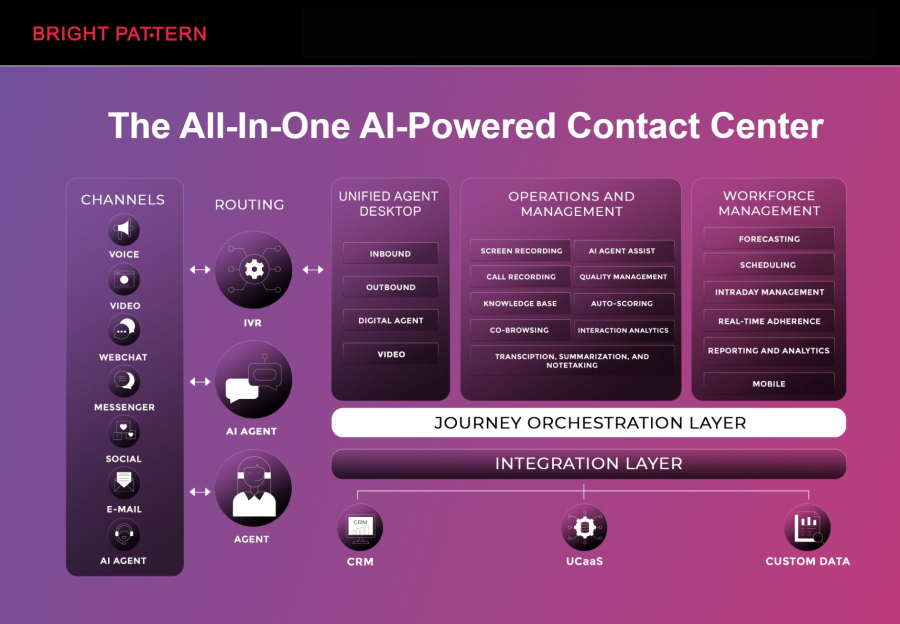
Why Bright Pattern stands out
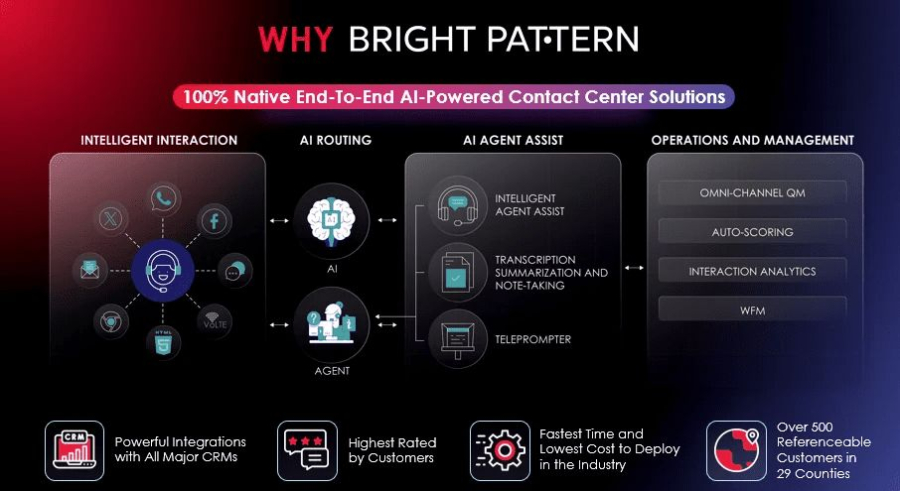
Bright Pattern is recognized as a top cloud-based omnichannel contact center solution. It leverages AI-powered automation, intelligent routing, and virtual agents to deliver seamless customer support across voice, chat, email, video, and messaging apps.
Key strengths of Bright Pattern’s AI contact center:
- Omnichannel customer engagement: Manage all interactions from a single platform — phone, chat, email, social media, and video — without losing context.
- AI virtual agents and automation: Automate repetitive tasks, answer common questions, and assist human agents for faster resolutions.
- Intelligent routing and agent assist: AI analyzes conversation context and customer history to route interactions to the right agent, improving first-contact resolution.
- Scalable cloud architecture: Easily adjust to seasonal demands or business growth with a flexible, cloud-native system.
- Insightful analytics and reporting: Track performance, monitor customer satisfaction, and gain actionable insights for continuous improvement.
Bright Pattern’s AI contact center solution enables businesses to combine automation, intelligent guidance, and human support for a faster, smoother, and more satisfying customer experience.
2–10: Other Notable AI Contact Center Platforms
|
# |
Platform |
AI & Contact Center Focus |
|
2. Genesys Cloud |
Offers scalable cloud contact center solutions with AI-powered routing, predictive analytics, and omnichannel engagement. |
|
|
3. NICE CXone |
Known for advanced analytics, AI-assisted agent workflows, and multichannel support for enterprise-level operations. |
|
|
4. Five9 Intelligent Cloud Contact Center |
Cloud platform with AI-driven call routing, virtual agents, and workflow automation for better efficiency. |
|
|
5. Talkdesk |
Provides AI-powered tools for small to mid-sized businesses, focusing on ease of use and intelligent automation. |
|
|
6. RingCentral Contact Center |
Cloud-native solution offering omnichannel support, AI-based routing, and integrated communication tools. |
|
|
Uses AI for voice analysis, call summaries, and virtual agent support to improve service quality. |
||
|
Cloud-native contact center with AI capabilities for predictive routing, virtual agents, and real-time insights. |
||
|
9. Cisco Webex Contact Center |
Enterprise-grade platform with AI-assisted workflows, omnichannel support, and secure infrastructure. |
|
|
10. Avaya Cloud Contact Center |
Hybrid and cloud options with AI-powered IVR, intelligent routing, and comprehensive analytics. |
What Is Voicebot AI?
Voicebot AIis an artificial intelligence system that allows people to interact with software using natural spoken language. It listens to what users say, converts speech to text, understands the intent behind the words, and responds with an appropriate answer or action, often using synthetic voice.
Unlike traditional IVR systems that rely on rigid number-based menus, modern voicebots usenatural language understandingso customers can speak freely, in their own words.
Key Capabilities of a Modern Voicebot
- Speech recognitionto turn spoken audio into accurate text.
- Natural language understandingto infer what the user is trying to achieve.
- Dialog managementto keep the conversation on track and handle follow-up questions.
- Integrations with business systemssuch as CRMs, booking tools, payment gateways, and knowledge bases.
- Text-to-speechto respond in a natural-sounding voice.
- Analyticsto track performance, detect bottlenecks, and guide optimization.
How Voicebot AI Works: From Speech to Intelligent Action
Under the hood, voicebot AI follows a clear sequence of steps that turn speech into meaningful action.
1. Speech Capture
The process starts when a user speaks into a phone, headset, or smart device. The voicebot captures this audio in real time.
2. Automatic Speech Recognition (ASR)
ASRtechnology converts the raw audio into text. Modern systems are trained on large volumes of speech data, allowing them to handle different accents, speech speeds, and background noise with increasing accuracy.
3. Natural Language Understanding (NLU)
Once speech is converted to text,NLUmodels analyze the sentence to determine the user’sintentand extract key information such as names, dates, or amounts. For example, the sentence "I want to change my flight to Friday evening" might trigger an intent like "modify_booking" and capture the new date and time.
4. Dialog Management
The dialog manager decides how the voicebot should respond. It considers the current request, previous steps in the conversation, and any missing information. If details are incomplete, the voicebot asks clarifying questions in a natural, conversational way.
5. Backend Actions and Integrations
The voicebot can connect to internal systems to perform tasks such as:
- Looking up customer profiles.
- Checking order status.
- Modifying reservations.
- Processing payments or refunds.
- Creating support tickets or leads.
6. Natural-Sounding Response
Finally, the voicebot formulates a response, converts it from text to speech usingtext-to-speech (TTS), and speaks back to the user. Advanced voicebots can adapt tone, pace, and emphasis to sound more human and engaging.
Core Business Benefits of Voicebot AI
Voicebot AI is not just a technology trend; it is a strategic asset that delivers measurable benefits across the organization.
1. 24/7 Availability Without Extra Staffing
With a voicebot, your business can provide round-the-clock assistance without hiring overnight teams. Customers can resolve common issues at any hour, on weekends, and during holidays, while your human agents focus on complex and high-value conversations.
2. Dramatically Reduced Wait Times
Voicebots handle multiple conversations in parallel. That means:
- Fewer call queues and shorter hold times.
- Smoother call peaks during campaigns, product launches, or seasonal spikes.
- Faster first-contact resolutions for routine queries.
3. Lower Service Costs Per Interaction
Automating frequent and repetitive requests significantly lowers the average cost per customer interaction. Instead of every inquiry requiring a live agent, voicebots take on high-volume, low-complexity tasks, allowing you to scale service without proportionally scaling headcount.
4. Consistent, High-Quality Answers
Voicebots rely on curated knowledge bases and structured flows, which means customers receive consistent information on pricing, policies, and processes. This reduces the risk of human error and creates a more predictable experience.
5. Higher Customer Satisfaction and Loyalty
Customers value fast, frictionless experiences. A well-designed voicebot can:
- Resolve issues on the first contact.
- Eliminate unnecessary transfers between departments.
- Offer personalized responses based on customer history and preferences.
These improvements can lead to higher satisfaction scores, stronger loyalty, and more positive word of mouth.
6. Rich Insights From Conversation Data
Every interaction with a voicebot generates data. By analyzing these conversations, you can uncover:
- Top customer questions and pain points.
- Gaps in your self-service content or product documentation.
- Opportunities for new features, services, or offerings.
These insights feed continuous improvement across customer experience, marketing, and product strategy.
High-Impact Use Cases for Voicebot AI
Voicebot AI is flexible and can support many scenarios across industries. Below are some of the most common and impactful applications.
Customer Support and Technical Help
Voicebots excel at handling common support requests, such as:
- Password resets or account unlocks.
- Order tracking and delivery updates.
- Basic troubleshooting steps for devices or apps.
- FAQs about policies, returns, and warranties.
When an issue becomes complex, the voicebot can hand off the conversation to a human agent, passing along relevant context to avoid customers repeating themselves.
Sales and Lead Qualification
In sales environments, voicebots can act as a proactive, always-on assistant that:
- Answers common pre-sales questions.
- Captures contact details and lead information.
- Qualifies prospects based on need, budget, or timeline.
- Books appointments or product demos with the appropriate team members.
This creates a smoother buying journey and ensures sales teams spend more time on high-potential opportunities.
Banking and Financial Services
In finance, voicebot AI supports secure, convenient self-service by helping customers:
- Check account balances and recent transactions.
- Review payment due dates and limits.
- Update contact details.
- Get information on cards, loans, and savings products.
With appropriate authentication steps, voicebots can assist with sensitive operations, while routing more complex financial advice to human specialists.
Telecommunications and Utilities
High-volume service providers use voicebots to streamline everyday inquiries, including:
- Outage information and estimated restoration times.
- Plan details, add-ons, and upgrades.
- Bill explanations and payment confirmations.
- Service activations and simple configuration steps.
Healthcare and Appointments
In healthcare and wellness, voicebots support better access and smoother operations by:
- Handling appointment scheduling and reminders.
- Answering basic questions about services, hours, or preparation instructions.
- Supporting medication reminders and follow-up check-ins, where appropriate.
While medical diagnosis remains the domain of licensed professionals, administrative workflows can be significantly streamlined with voice automation.
Travel, Hospitality, and Logistics
From booking to post-trip support, voicebots contribute to a seamless journey by:
- Helping customers search and book flights, hotels, or rentals.
- Providing real-time updates on reservations, delays, or gate changes.
- Managing simple changes, such as seat selection or late check-out requests.
Voicebot AI vs. Chatbots: What Is the Difference?
Voicebots and chatbots are closely related, but they focus on different input and output channels.
|
Aspect |
Voicebot AI |
Chatbot |
|
Primary channel |
Spoken conversations via phone or voice-enabled devices |
Text-based chats via web, apps, or messaging platforms |
|
Input mode |
User talks |
User types or taps options |
|
Output mode |
Synthesized speech |
Text replies, buttons, and media |
|
User context |
Often mobile, on the move, hands-free |
Often at a screen, able to read and type |
|
Implementation |
Requires telephony or voice integration plus ASR and TTS |
Requires chat interface, no audio stack needed |
In practice, many organizations deploy both, creating anomnichannel virtual assistantthat can serve customers in the way that feels most natural to them.
Designing an Effective Voicebot: Best Practices
The strongest results come from thoughtful design. Below are practical guidelines to build a voicebot that customers actually enjoy using.
1. Start With Clear, High-Value Use Cases
Begin with tasks that are:
- High in volume.
- Relatively simple and structured.
- Valuable when handled quickly.
Examples include checking order status, resetting passwords, or updating contact details. Fast wins build momentum and internal support for expanding the voicebot’s scope.
2. Use Natural, Friendly Language
Write conversational scripts that sound like a helpful human, not a machine. That includes:
- Short sentences and clear prompts.
- Polite confirmations, such as "Got it" or "Let me check that for you".
- Everyday words instead of jargon where possible.
A friendly tone encourages customers to stay engaged and complete tasks through self-service.
3. Design for Clarification and Recovery
No system is perfect, and background noise or ambiguous phrases will occur. Plan for this by:
- Offering brief re-prompts when the user is not understood.
- Confirming critical information, such as dates or amounts.
- Providing a clear, easy way to reach a human agent when needed.
This approach keeps interactions smooth and maintains user trust.
4. Personalize When Appropriate
Where privacy and regulations allow, integrate the voicebot with customer profiles to deliver tailored experiences, such as:
- Greeting returning customers by name.
- Referencing recent orders or support cases.
- Offering recommendations based on past behavior.
Personalization makes the voicebot feel more like a dedicated assistant than a generic system.
5. Connect Deeply With Your Systems
The more your voicebot can actuallydo, the more valuable it becomes. To achieve this, connect it to:
- CRM and customer databases.
- Order management and billing systems.
- Appointment schedulers and booking engines.
- Knowledge bases and FAQ repositories.
Robust integrations turn your voicebot into a powerful, end-to-end self-service channel.
6. Monitor, Measure, and Continuously Improve
Treat your voicebot as a living product. Track metrics such as:
- Containment rate (interactions resolved without human transfer).
- Average handling time.
- Customer satisfaction scores or post-call surveys.
- Drop-off points in key workflows.
Use this data to refine prompts, fill content gaps, and optimize flows over time.
Key Metrics to Evaluate Voicebot Success
To demonstrate impact, align voicebot performance with measurable business outcomes.
Operational Metrics
- Call deflectionfrom live agents to the voicebot.
- First-contact resolutionfor automated interactions.
- Average handling timecompared to human-only processes.
- Self-service completion ratefor top journeys.
Customer Experience Metrics
- Customer satisfactionafter voicebot interactions.
- Net Promoter Scoreshifts correlated with improved support.
- Abandonment rateduring calls or tasks.
Financial Metrics
- Cost per interaction with and without automation.
- Agent capacity freed for higher-value tasks.
- Revenue uplift from better lead capture and faster responses.
Getting Started With Voicebot AI in Your Organization
Implementing voicebot AI does not need to be overwhelming. A structured approach keeps the project focused and results-driven.
Step 1: Define Objectives and Scope
Clarify what success looks like. Are you aiming to reduce call volume, improve first-contact resolution, extend hours of service, or support a new product launch? Set clear, measurable goals and identify the top three use cases to implement first.
Step 2: Map Customer Journeys
Document how customers currently seek help or perform tasks. Identify friction points, repetitive questions, and common handoffs. This will guide which parts of the journey are ideal for voice automation.
Step 3: Choose a Voicebot Platform or Partner
Consider factors such as:
- Quality of speech recognition and natural language understanding.
- Ease of integration with your existing systems.
- Tools for building, testing, and updating conversation flows.
- Analytics and reporting capabilities.
- Support for your required languages and channels.
Step 4: Design, Test, and Iterate
Collaborate across customer service, product, and technical teams to design flows. Run pilot programs with real customers or internal users, collect feedback, and refine the experience before scaling.
Step 5: Launch and Promote
Once your voicebot is ready, make sure customers know about it. Promote it through your IVR menus, email campaigns, or account notifications. Clear communication drives adoption and helps customers understand the benefits of the new experience.
The Future of Voicebot AI
Voicebot AI continues to evolve rapidly, driven by advances in machine learning, cloud computing, and natural language processing. Looking ahead, you can expect:
- More human-like conversationsas models better understand context, emotion, and nuance.
- Deeper personalizationthrough secure use of customer data and preferences.
- Seamless channel switchingso customers can move from voice to chat or email without losing context.
- Expanded multilingual capabilitiesto support global audiences with high accuracy.
Organizations that embrace voicebot AI now will be well positioned to leverage these innovations, delight customers, and stay ahead of the competitive curve.
Conclusion: Turning Voice Into a Strategic Advantage
Voicebot AI turns natural speech into a powerful, scalable interface between your business and your customers. By automating routine conversations, providing around-the-clock support, and integrating deeply with your systems, voicebots unlock faster service, lower costs, and stronger relationships.
Whether you are just exploring automation or ready to expand existing self-service capabilities, now is the ideal time to invest in voicebot AI. With the right strategy, design, and measurement, your voicebot can become a standout differentiator and a key driver of long-term customer success.
